Data Encoding: The Universal Translator Between Memory and Bytes
Ever wondered why you can't just dump your Python objects directly to disk and expect Java to read them? Discover why encoding matters, why pickle is dangerous, and how backward/forward compatibility enables zero-downtime deployments.
Why This Matters
Ever wondered why you can't just dump your Python objects directly to disk and expect Java to read them? Or why that pickle.load() call feels dangerous? The moment your data leaves your program's memory, you enter the world of encoding—the art of translating data structures into bytes that can travel across networks, persist to disk, and be understood by completely different systems.
Real-world relevance: Every microservice, every API, every database you've ever used relies on encoding. Get it wrong, and you're locked into a single language forever—or worse, you've opened a security vulnerability that lets attackers execute arbitrary code on your servers.
Learning Objectives
- [ ] Understand the fundamental difference between in-memory and serialized data representations
- [ ] Compare language-specific encoding formats and identify their critical limitations
- [ ] Apply the concepts of backward and forward compatibility to real system designs
- [ ] Evaluate when to avoid language-built-in serialization (hint: almost always in production)
The Big Picture: Two Worlds of Data
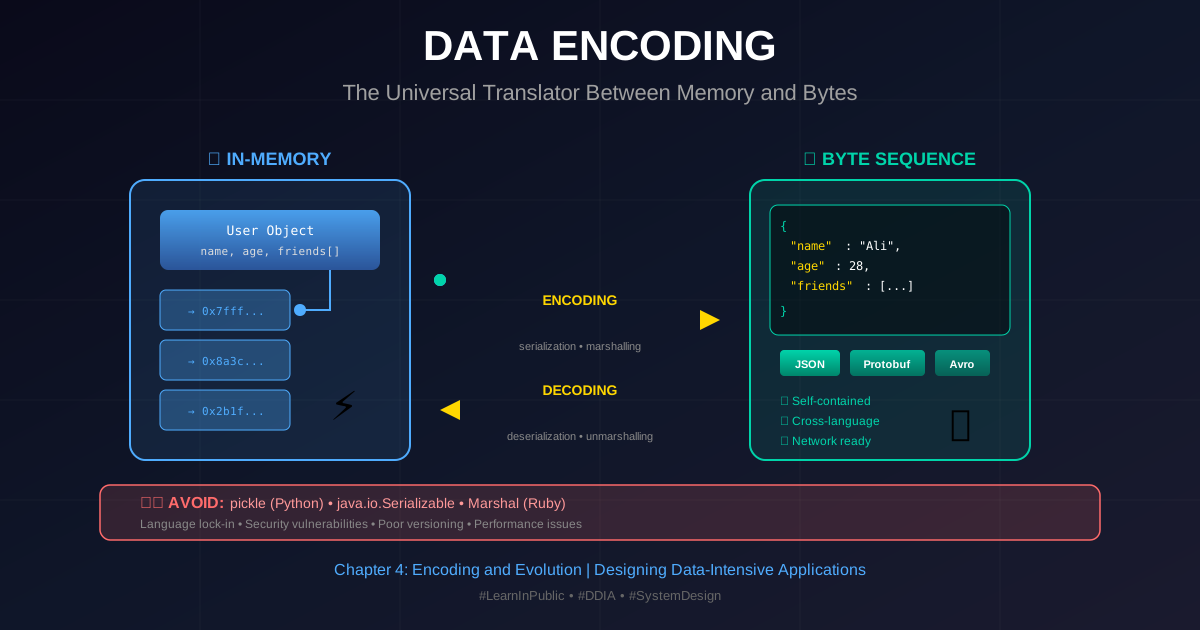
Data lives in two fundamentally different worlds, and it needs a passport to travel between them.
World 1: In-Memory Land
When your program runs, data exists as objects, structs, lists, arrays, hash tables, and trees. These structures are optimized for one thing: making the CPU happy. They use pointers—memory addresses that let the CPU jump instantly from one piece of data to another.
┌─────────────────────────────────────────────────────────┐
│                    YOUR PROGRAM'S MEMORY                 │
├─────────────────────────────────────────────────────────┤
│                                                          │
│   User Object           Address Book                    │
│   ┌──────────────┐     ┌──────────────┐                │
│   │ name: "Ali"  │     │ contacts[0]──┼──► [pointer]   │
│   │ age: 28      │     │ contacts[1]──┼──► [pointer]   │
│   │ friends──────┼──►  │ contacts[2]──┼──► [pointer]   │
│   └──────────────┘     └──────────────┘                │
│                                                          │
│   ⚡ Fast: CPU loves pointers!                          │
│   ❌ Problem: Pointers are meaningless outside memory   │
└─────────────────────────────────────────────────────────┘
World 2: Byte Sequence Land
When data needs to leave your program—written to disk, sent over the network, or stored in a database—it must become a self-contained sequence of bytes. No pointers allowed. Everything must be spelled out explicitly.
┌─────────────────────────────────────────────────────────┐
│                    BYTE SEQUENCE                         │
├─────────────────────────────────────────────────────────┤
│                                                          │
│   {"name":"Ali","age":28,"friends":["Bob","Carol"]}     │
│                                                          │
│   📦 Self-contained: No external references             │
│   🌐 Portable: Any system can read these bytes          │
│   🐢 Slower: Must parse and rebuild structures          │
└─────────────────────────────────────────────────────────┘
Core Concept: Encoding and Decoding
The translation between these two worlds has several names (all meaning the same thing):
Diagram Explanation: This shows the bidirectional translation between in-memory representations and byte sequences. The process of converting to bytes is called encoding (also known as serialization or marshalling). The reverse process is decoding (also known as deserialization, parsing, or unmarshalling).
⚠️ Terminology Warning: "Serialization" also appears in database transaction contexts (Chapter 7) with a completely different meaning. To avoid confusion, Kleppmann prefers "encoding"—and so should you in distributed systems discussions.
The Problem with Language-Specific Formats
Every major programming language offers a built-in way to encode objects:
| Language | Built-in Encoding |
|----------|-------------------|
| Java | java.io.Serializable |
| Ruby | Marshal |
| Python | pickle |
| JavaScript | JSON.stringify() (limited) |
| C#/.NET | BinaryFormatter |
These seem convenient—just call one function and your object becomes bytes! But they hide four critical problems:
❌ Problem 1: Language Lock-in
Diagram Explanation: When you use pickle in Python, you've silently committed your entire organization to Python forever. That data cannot be read by Java, Go, Rust, or any other language. You've created a prison for your data.
❌ Problem 2: Security Nightmare
This is the scariest one. When you decode a byte stream, the decoder needs to instantiate classes. An attacker can craft malicious bytes that trigger arbitrary code execution:
# ⚠️ DANGER: Never do this with untrusted data!
import pickle

# Attacker sends this payload
malicious_data = b"cos\nsystem\n(S'rm -rf /'\ntR."

# Victim runs this innocent-looking code
pickle.loads(malicious_data)  # 💀 Executes: rm -rf /
🔴 Security Alert: In 2015, a vulnerability in Apache Commons Collections allowed attackers to execute arbitrary code on any Java server that deserialized untrusted data. This affected WebLogic, JBoss, Jenkins, and hundreds of enterprise applications.
❌ Problem 3: Versioning is an Afterthought
What happens when you add a new field to your class? Or rename one? Language-specific encoders typically break:
# Version 1 of your code
class User:
    name: str
    email: str

# Version 2 (you added a field)
class User:
    name: str
    email: str
    phone: str  # NEW!

# Now try to load old data... 💥
# pickle often throws: AttributeError: 'User' has no attribute 'phone'
❌ Problem 4: Performance Disaster
Java's Serializable is notoriously slow and bloated. A simple object can expand 5-10x when serialized:
┌────────────────────────────────────────────────────────┐
│ Encoding Performance Comparison (lower is better)      │
├────────────────────────────────────────────────────────┤
│                                                         │
│ Protocol Buffers ████░░░░░░░░░░░░░░░░ 23 bytes         │
│ JSON             ████████░░░░░░░░░░░░ 82 bytes         │
│ Java Serialize   █████████████████████ 213 bytes       │
│                                                         │
│ Encoding time:                                          │
│ Protocol Buffers ██░░░░░░░░░░░░░░░░░░ 0.5μs            │
│ JSON             ████████░░░░░░░░░░░░ 2.1μs            │
│ Java Serialize   ████████████████████ 5.8μs            │
│                                                         │
└────────────────────────────────────────────────────────┘
The Compatibility Contract
When you're building distributed systems, you can't update all code at once:
- Server-side: Rolling upgrades deploy new code to a few nodes at a time
- Client-side: Mobile users might not update for months (or ever)
This means old and new code versions will coexist, reading each other's data. You need two types of compatibility:
Diagram Explanation: The two arrows show the two directions of compatibility:
- Backward compatibility (easier): New code can read old data—you know the old format, so handle it
- Forward compatibility (harder): Old code can read new data—requires ignoring unknown fields
Real-World Analogy
Think of encoding like translating a book into Braille.
Your brain (the CPU) processes the original text using a complex web of associations—you "see" the word "apple" and immediately connect it to images, tastes, and memories. These are like pointers.
But to share with someone who reads Braille, you must encode it into a linear sequence of dots that fully represents each letter. No shortcuts, no associations—just a self-contained representation that anyone with Braille knowledge can decode.
Similarly, your program's objects (with all their pointer magic) must be converted into a universal byte format that any other program can understand—even programs written in different languages, running on different machines, built years later.
Practical Example: Why Pickle Fails in Production
Let's see the compatibility problem in action:
import pickle
import json

# ============================================
# SCENARIO: Microservice communication
# ============================================

class UserV1:
    """Original user class"""
    def __init__(self, name: str, email: str):
        self.name = name
        self.email = email

class UserV2:
    """Updated user class with new field"""
    def __init__(self, name: str, email: str, phone: str = None):
        self.name = name
        self.email = email
        self.phone = phone  # New field!

# Create a V1 user
user_v1 = UserV1("Alice", "alice@example.com")

# ❌ PICKLE APPROACH - Fragile!
# ---------------------------------
pickled = pickle.dumps(user_v1)
print(f"Pickle size: {len(pickled)} bytes")
# If UserV1 class definition changes, this breaks!

# ✅ JSON APPROACH - Robust!
# ---------------------------------
def to_dict(user):
    return {k: v for k, v in user.__dict__.items()}

json_bytes = json.dumps(to_dict(user_v1)).encode('utf-8')
print(f"JSON size: {len(json_bytes)} bytes")

# V2 code can read V1 data and handle missing fields
v1_data = json.loads(json_bytes)
user_v2 = UserV2(
    name=v1_data["name"],
    email=v1_data["email"],
    phone=v1_data.get("phone")  # Gracefully handles missing field!
)

print(f"✅ Backward compatible: {user_v2.name}, phone={user_v2.phone}")

# Output:
# Pickle size: 89 bytes
# JSON size: 47 bytes
# ✅ Backward compatible: Alice, phone=None
Key Insight: JSON is ~50% smaller AND handles schema evolution gracefully. The new phone field simply returns None for old data—no crashes, no exceptions.
Key Takeaways
-
Two representations exist: In-memory (optimized for CPU with pointers) and byte sequences (self-contained, portable). You MUST translate between them.
-
Encoding = Serialization = Marshalling: These three terms mean the same thing—converting from memory to bytes. Decoding goes the other direction.
-
Avoid language-specific formats in production:
pickle,java.io.Serializable, andMarshallock you into one language, create security holes, break on schema changes, and waste bytes. -
Compatibility is bidirectional: Backward compatibility (new reads old) is easy. Forward compatibility (old reads new) requires old code to ignore unknown fields—plan for it!
-
Rolling upgrades require both: In production, old and new code coexist. Your encoding format must support both compatibility directions to enable zero-downtime deployments.
Common Pitfalls
❌ Pitfall: "I'll use pickle for quick prototyping and switch later"
✅ Reality: Prototypes become production. Use JSON or Protocol Buffers from day one—the migration pain isn't worth the shortcut.
❌ Pitfall: "Only my Python service reads this data"
✅ Reality: Until next quarter when the team adds a Go analytics service, or three years from now when you migrate to a different language.
❌ Pitfall: "I'll just require all clients to update simultaneously"
✅ Reality: Mobile apps can't be forced to update. Even server deploys use rolling upgrades. Simultaneous updates are a myth at scale.
❌ Pitfall: "Schema changes are rare"
✅ Reality: Business requirements change constantly. Every new field, every renamed property is a schema change. Build for evolution.
❌ Pitfall: "JSON is human-readable so it's always the right choice"
✅ Reality: JSON lacks schemas, has poor number handling (no integers!), and is verbose. For high-performance systems, consider Protocol Buffers or Avro.
Interview Prep
Q: What's the difference between serialization and encoding?
A: They're the same thing—different terms for converting in-memory data structures to byte sequences. "Serialization" is more common in Java/.NET circles; "encoding" is preferred in distributed systems to avoid confusion with transaction serialization.
Q: Why shouldn't you use language-built-in serialization in production?
A: Four reasons: (1) Language lock-in—other languages can't read the data, (2) Security—deserializing untrusted data enables code execution attacks, (3) Poor versioning—schema changes often break compatibility, (4) Performance—bloated output and slow encoding.
Q: What's the difference between backward and forward compatibility?
A: Backward: new code reads old data (easier—you know the old format). Forward: old code reads new data (harder—requires ignoring unknown fields). Both are needed for rolling upgrades.
Q: How do rolling upgrades relate to encoding formats?
A: During rolling upgrades, old and new code versions run simultaneously. Data written by new code must be readable by old code (forward compatibility), and vice versa (backward compatibility). Encoding formats like Protocol Buffers and Avro are designed for this.
What's Next?
Now that you understand why language-specific formats are dangerous, we'll explore the alternatives:
- JSON and XML — Human-readable formats with their own trade-offs
- Binary encoding libraries — Thrift, Protocol Buffers, and Avro
- Schema evolution — How these formats handle adding/removing fields gracefully
The next section dives into JSON, XML, and Binary Variants, where we'll see how these universal formats solve (and sometimes create) problems.