Designing Scalable and Secure Azure Network Architecture with VNet Peering
Implemented a scalable and secure Azure VNet peering architecture with a hub-spoke model for a multinational software firm, enabling cross-region and cross-tenant connectivity.
Technologies
Challenges
Solutions
Key Results
Achieved sub-millisecond latency and high throughput
performance gains
Enabled peering setup without traffic interruption
zero downtime
Facilitated secure resource sharing across tenants
multi tenant collaboration
Supported dynamic address space updates
scalable design
Ensured fine-grained traffic control and centralized logging
security visibility
Designing Scalable and Secure Azure Network Architecture with VNet Peering
AMJ Cloud Technologies partnered with a multinational software development firm to design a scalable and secure Azure network architecture using VNet peering. This case study details how we enabled cross-region, cross-subscription, and cross-tenant connectivity for their distributed workloads.
Situation
The client, operating across North America, Europe, and Asia, was migrating to Azure with workloads including development environments, CI/CD pipelines, analytics platforms, and SaaS applications. Each business unit used separate Azure subscriptions and tenants, requiring isolated yet interconnected networking.
Challenge
The client needed a network architecture that:
- Supported secure, low-latency communication across VNets and regions.
- Enabled cross-subscription and cross-tenant connectivity without early reliance on VPN or ExpressRoute.
- Implemented hub-spoke topologies with centralized governance.
- Was scalable for future acquisitions and expansion.
- Enforced security policies across interconnected environments.
- Avoided costly virtual appliances or firewalls.
Solution: Implementing Azure VNet Peering with a Hub-Spoke Model
We designed a VNet peering strategy with a hub-spoke model, implemented over ten weeks by a team of cloud architects and network engineers.
Action
Key design choices included:
-
Regional and Global Peering:
- Peered VNets within regions (e.g., development, testing, production) for high-performance communication.
- Used global peering to interconnect regional hubs (North America ↔ Europe ↔ Asia) for replication and disaster recovery.
-
Hub-Spoke Topology:
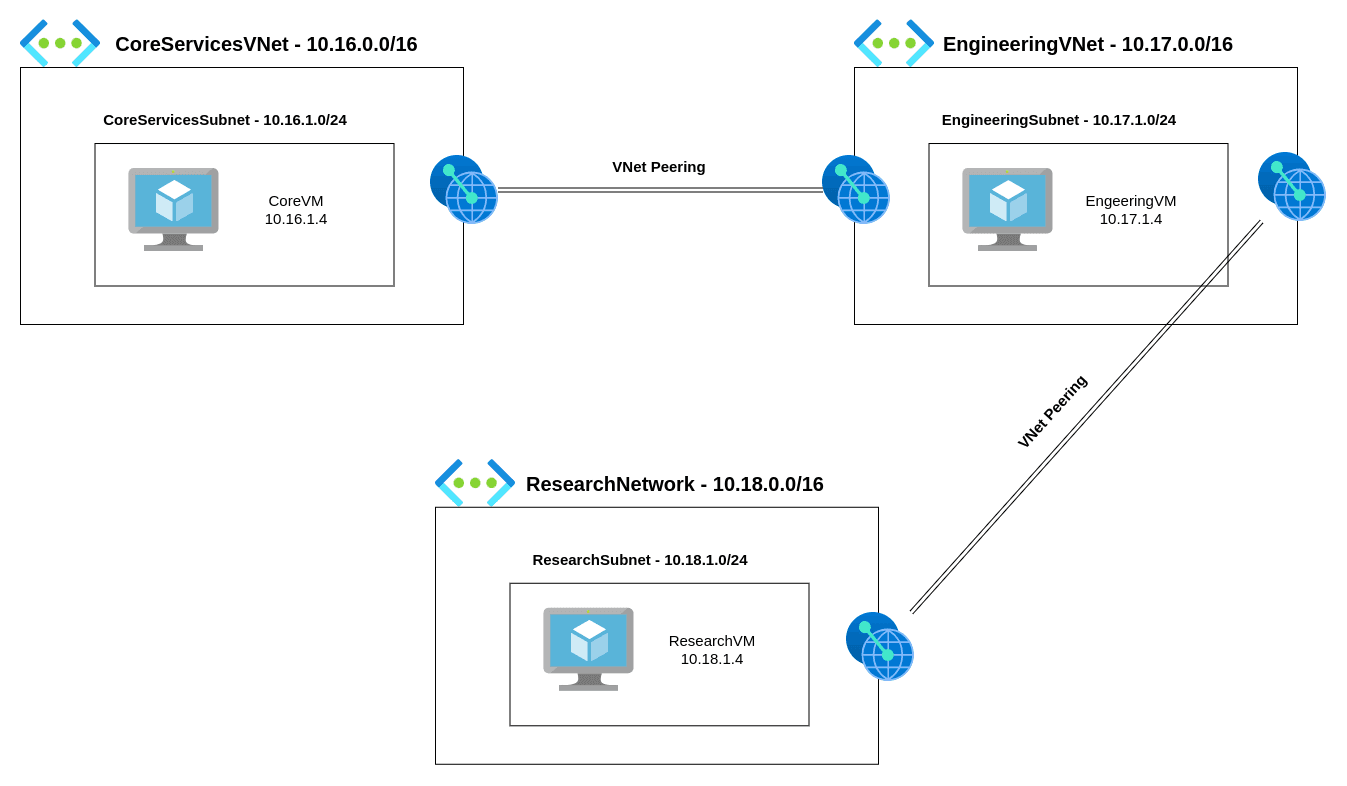
- Deployed a CoreServices VNet per region as a hub, hosting Azure Firewall, jumpboxes, DNS forwarders, and logging services.
- Peered spoke VNets (e.g., DevVNet, ProdVNet) directly with the hub.
-
Cross-Subscription and Cross-Tenant Peering:
- Enabled seamless communication across Azure AD tenants using RBAC (Network Contributor role) for secure peering setup.
-
Dual-Stack Compatibility:
- Designed for IPv4 and IPv6 to support future networking standards.
-
Address Space Governance:
- Ensured non-overlapping CIDR ranges to meet VNet peering requirements.
-
Security Enforcement:
- Applied NSGs for least privilege access and Azure Policy to prevent resource exposure.
-
Testing and Validation:
- Validated low-latency communication, security policies, and scalability through performance and compliance testing.
Results
The solution delivered significant outcomes:
- Performance Gains: Achieved sub-millisecond latency and high throughput via Azure’s backbone.
- Zero Downtime Deployments: Peering setup and modifications caused no traffic interruptions.
- Simplified Multi-Tenant Collaboration: Enabled secure resource sharing across tenants.
- Future-Proof Design: Supported dynamic address space updates for scalability.
- Visibility and Security: Provided fine-grained traffic control and centralized logging.
Challenges Addressed
- Transitive Routing Awareness: Educated teams on non-transitive peering limitations, ensuring proper hub-spoke design.
- Peering Limits Management: Avoided Azure’s 500-peer limit through careful segmentation.
Technologies Used
- Azure Virtual Network (VNet): Foundation for network segmentation.
- VNet Peering (Regional & Global): Enabled secure connectivity.
- Hub-Spoke Architecture: Centralized shared services.
- Azure Network Security Groups (NSGs): Enforced granular security.
- Azure Firewall (Centralized Security): Provided centralized traffic inspection.
- IPv6 Dual-Stack Configuration: Prepared for future standards.
- Azure Policy & Role-Based Access Control (RBAC): Ensured governance.
- Azure Monitor & Network Watcher: Facilitated monitoring.
Key Use Cases
This architecture is ideal for:
- Multinational firms requiring cross-region and cross-tenant connectivity.
- Organizations needing scalable, secure hub-spoke topologies.
- Businesses planning for rapid expansion or acquisitions.
Key Takeaways
VNet peering with a hub-spoke model enabled a performant, secure, and modular Azure network. By addressing non-transitive routing and peering limits, we delivered a production-grade backbone for cross-region and cross-tenant collaboration. AMJ Cloud Technologies is dedicated to crafting scalable cloud solutions.
Ready to design a scalable Azure network? Contact us to explore how AMJ Cloud Technologies can help.
Architectural Diagram
Need a Similar Solution?
I can help you design and implement similar cloud infrastructure and DevOps solutions for your organization.