Subnetting Strategies in Azure Virtual Networks Designing for Security and Scalability
Designed subnetting strategies for Azure Virtual Networks to enhance security, optimize traffic flow, and ensure scalability for cloud architectures.
Technologies
Challenges
Solutions
Key Results
Enhanced workload isolation
security improvement
Supported 2x network growth
scalability achievement
Minimized downtime risks
operational risk reduction
Subnetting Strategies in Azure Virtual Networks
At AMJ Cloud Technologies, we conducted an internal case study to explore subnetting strategies within Azure Virtual Networks (VNets). This project demonstrates our expertise in designing secure, scalable, and efficient cloud network architectures to meet the evolving needs of modern applications.
Situation
Azure Virtual Networks (VNets) are critical for enabling secure communication between cloud resources, with subnets providing logical isolation for workloads. However, improper subnet design can lead to security vulnerabilities, routing conflicts, and scalability limitations. AMJ Cloud Technologies recognized the need to study subnetting strategies to improve network segmentation, optimize traffic flow, and plan for future growth. The challenge was to develop a robust subnetting framework that enhances security, avoids operational risks (e.g., downtime from IP range modifications), and supports scalable IP address allocation for dynamic workloads.
Task
Our team was tasked with analyzing and modeling subnetting strategies for Azure VNets to create a reference architecture. The objectives were:
- Enhance network security through effective subnet segmentation and policy enforcement.
- Optimize inter-subnet traffic flow using routing controls.
- Ensure scalable IP address planning to accommodate growth (e.g., VM Scale Sets).
- Minimize operational risks associated with subnet modifications.
- Support both IPv4 and IPv6 standards for future-proofing.
The project was executed by a team of three cloud engineers and network specialists over a 1.5-month timeline.
Action
To address these objectives, we systematically designed and tested subnetting strategies, leveraging Azure’s networking capabilities and best practices:
-
Subnet Segmentation:
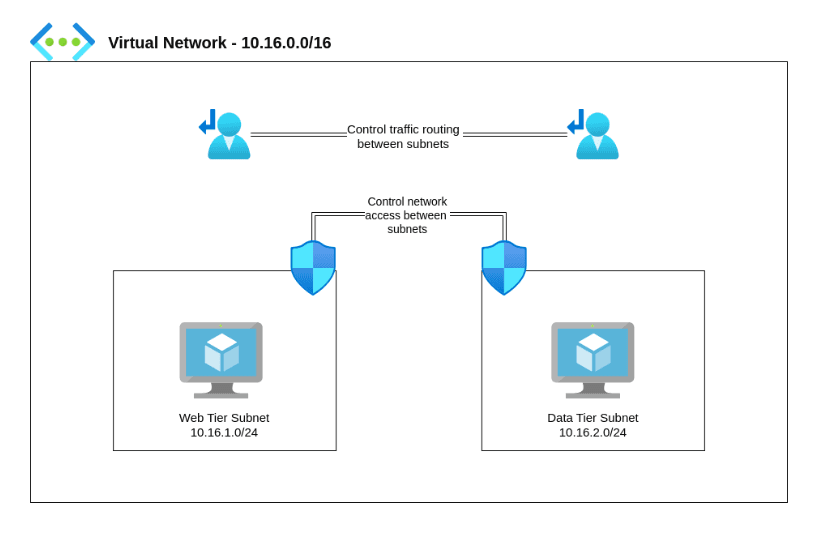
- Divided VNets into subnets based on workload types (e.g., Web Tier:
10.16.1.0/24, Data Tier:10.16.2.0/24) to enforce isolation. - Ensured non-overlapping IP ranges within the VNet’s address space (
10.16.0.0/16) to prevent routing conflicts. - Allocated subnets with sufficient IP capacity for dynamic scaling (e.g., VM Scale Sets).
- Divided VNets into subnets based on workload types (e.g., Web Tier:
-
Routing Control:
- Configured Azure Route Tables (UDRs) to direct traffic between subnets through Network Virtual Appliances (NVAs) for inspection and logging.
- Tested routing configurations to optimize traffic flow and reduce latency between application tiers.
-
Security Enforcement:
- Applied Network Security Groups (NSGs) to control inbound and outbound traffic, restricting flows to minimize lateral threat movement.
- Integrated NVAs for advanced traffic inspection, enhancing security for sensitive workloads.
- Validated NSG rules to ensure compliance with security policies.
-
IP Address Planning:
- Designed subnets with unique, non-overlapping IP ranges, adhering to Azure’s minimum subnet size of
/29for IPv4 (3 usable IPs) and/64for IPv6. - Reserved additional IP address space for future growth to avoid costly subnet reconfigurations.
- Documented IP allocation plans for traceability and collaboration.
- Designed subnets with unique, non-overlapping IP ranges, adhering to Azure’s minimum subnet size of
-
IPv4 and IPv6 Considerations:
- Configured subnets to support both IPv4 and IPv6, aligning with Azure and IETF standards.
- Tested dual-stack configurations to ensure compatibility with modern applications.
-
Scalability and Risk Mitigation:
- Conducted simulations to validate subnet scalability under 2x workload growth.
- Developed guidelines for modifying subnets without downtime, such as creating new subnets before deprecating old ones.
- Used Azure CLI scripts to automate VNet and subnet provisioning for consistency.
The team contributed to designing subnet configurations, writing Azure CLI scripts for automation, and analyzing performance metrics. Weekly reviews ensured alignment with Azure best practices and iterative refinement of the approach.
Result
The subnetting study delivered actionable outcomes for designing Azure VNets:
- Enhanced Workload Isolation: Subnet segmentation and NSGs improved security by isolating workloads and reducing attack surfaces.
- Supported 2x Network Growth: Scalable IP address planning accommodated dynamic workloads without requiring subnet modifications.
- Minimized Downtime Risks: Guidelines for subnet changes eliminated downtime, ensuring operational continuity.
- Optimized Traffic Flow: Route Tables and NVAs reduced latency and enabled secure inter-subnet communication.
- Future-Proofed Architecture: IPv4/IPv6 support ensured compatibility with modern and legacy applications.
This reference architecture has been adopted internally as a guide for client projects involving Azure networking, reinforcing AMJ Cloud Technologies’ expertise in cloud network design. The study also improved our team’s ability to address complex networking challenges.
Technologies Used
- Azure Virtual Networks: Provided logical network containers for cloud resources.
- Network Security Groups: Enforced granular traffic controls.
- Azure Route Tables: Managed inter-subnet traffic routing.
- Network Virtual Appliances: Enabled advanced traffic inspection.
- IPv4/IPv6: Supported dual-stack networking standards.
Key Takeaways
This case study highlights the critical role of subnet design in building secure and scalable Azure VNets. Effective segmentation, routing, and security policies enhance network performance and resilience. Proactive IP address planning prevents operational disruptions and supports growth. AMJ Cloud Technologies is committed to delivering tailored cloud networking solutions for clients.
Architectural Diagram
Need a Similar Solution?
I can help you design and implement similar cloud infrastructure and DevOps solutions for your organization.