Message-Passing Dataflow: Fire and Forget
RPC demands an immediate response. Databases store data indefinitely. But what if you want the best of both worlds? Message passing gives you the low latency of RPC with the durability and decoupling of databases.
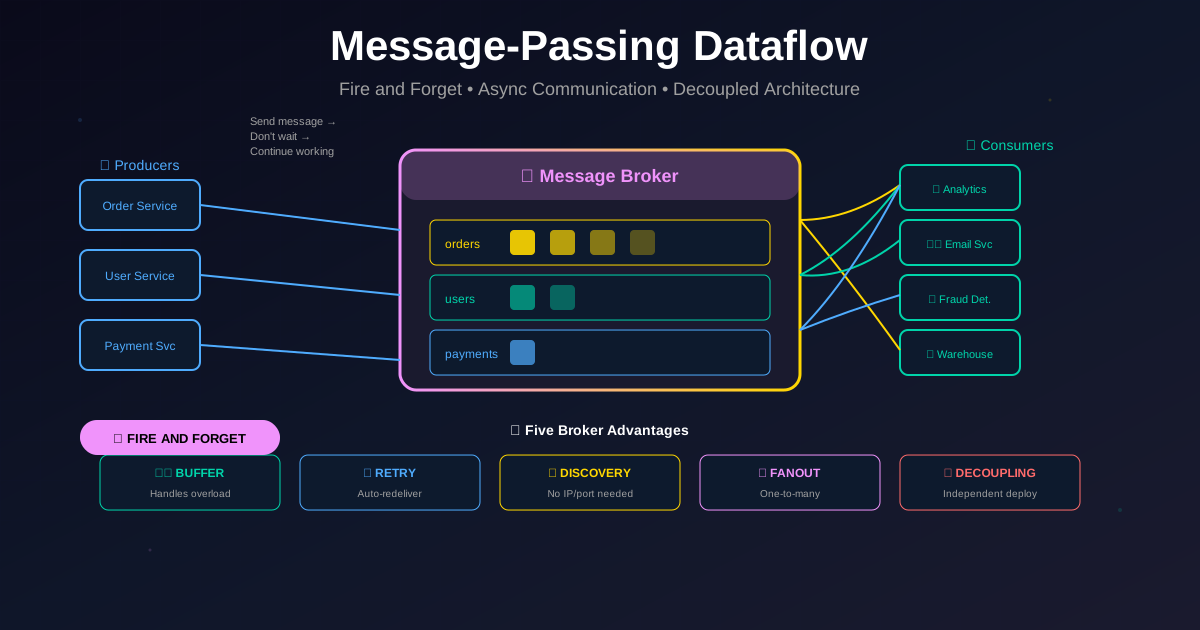
Why This Matters
RPC demands an immediate response. Databases store data indefinitely. But what if you want the best of both worlds? Message passing gives you the low latency of RPC with the durability and decoupling of databases. You send a message, and then... you forget about it. The broker handles the rest.
Real-world relevance: LinkedIn uses Kafka to process trillions of messages daily. Netflix decouples hundreds of microservices with async messaging. Understanding message-passing patterns is essential for building scalable, resilient distributed systems.
Learning Objectives
- [ ] Understand how message passing combines RPC's latency with database durability
- [ ] Compare the five advantages of message brokers over direct RPC
- [ ] Apply pub/sub patterns and message routing for decoupled architectures
- [ ] Evaluate when to use distributed actor frameworks (Akka, Orleans, Erlang)
The Big Picture: The Third Way
We've explored three modes of dataflow. Message passing is the hybrid:
Diagram Explanation: RPC is synchronous with direct connections. Databases are for long-term storage. Message passing combines low latency (like RPC) with durability and decoupling (like databases), using a broker as intermediary.
The Five Advantages of Message Brokers
Why use a broker instead of direct service calls? Five powerful reasons:
Diagram Explanation: Message brokers provide buffering during traffic spikes, automatic retry on failures, service discovery, fan-out to multiple consumers, and logical decoupling between sender and receiver.
Detailed Breakdown
| Advantage | Problem It Solves | How It Works | |-----------|------------------|--------------| | Buffer | Recipient overloaded or down | Broker queues messages until recipient is ready | | Retry | Process crashes mid-work | Broker redelivers unacknowledged messages | | Discovery | Cloud VMs come and go | Consumers connect to broker, not producers | | Fanout | One event needs multiple handlers | Publish once, multiple subscribers receive | | Decoupling | Tight service coupling | Producer publishes; doesn't care who consumes |
Message Broker Architecture
The core pattern: producers send messages to queues/topics, and consumers receive them:
Diagram Explanation: Multiple producers publish to topics. The broker routes messages to subscribers. Notice how Analytics subscribes to ALL topics, while Warehouse only cares about orders. This is the power of decoupling.
Queue vs Topic
| Concept | Behavior | Use Case | |---------|----------|----------| | Queue | Each message goes to ONE consumer | Work distribution, load balancing | | Topic | Each message goes to ALL subscribers | Event broadcasting, fan-out |
One-Way Communication: The Key Difference
Unlike RPC, message passing is typically one-way:
Diagram Explanation: The producer sends and immediately moves on—it doesn't block waiting for a response. If a reply is needed, the consumer publishes to a separate reply topic. This is fundamentally different from RPC's request-response pattern.
Async Patterns
| Pattern | Description | Example | |---------|-------------|---------| | Fire-and-forget | Send message, don't expect reply | Logging, metrics, analytics events | | Request-reply | Reply on separate topic | Order creation → Order confirmation | | Publish-subscribe | One producer, many consumers | Price updates to all trading systems | | Work queue | Multiple consumers share workload | Image processing, email sending |
Popular Message Brokers
The landscape has evolved from enterprise software to open source:
Diagram Explanation: The message broker landscape shifted from expensive enterprise software to open-source alternatives. Kafka dominates high-throughput streaming; RabbitMQ excels at complex routing; NATS is popular for cloud-native microservices.
When to Use Which
| Broker | Best For | Key Feature | |--------|----------|-------------| | Kafka | Event streaming, log aggregation, high throughput | Persistent log, replay capability | | RabbitMQ | Complex routing, traditional messaging | Flexible exchanges, dead-letter queues | | NATS | Lightweight microservice communication | Simple, low latency, cloud-native | | Amazon SQS | Serverless, AWS-native | Fully managed, no ops overhead |
Schema Evolution in Message Passing
Messages are just bytes—use any encoding format. But compatibility still matters:
Diagram Explanation: The broker doesn't enforce schemas—it just moves bytes. Producers and consumers can evolve independently IF they use compatible encoding (Protobuf, Avro). Use backward/forward compatible schemas for independent deployment.
Warning: If a consumer republishes messages to another topic, be careful to preserve unknown fields—the same problem we saw with databases!
Distributed Actor Frameworks
The actor model is a different approach to concurrency and distribution:
Diagram Explanation: Each actor has private state and a mailbox. Actors communicate ONLY via async messages—no shared memory. One message is processed at a time, eliminating race conditions and locks.
Why Actors Handle Location Transparency Better
Remember RPC's location transparency problem? The actor model handles it better:
| Aspect | RPC | Actor Model | |--------|-----|-------------| | Message loss | Assumed rare, causes bugs | Expected, built into model | | Latency variance | Surprising, poorly handled | Expected, async by default | | Retry semantics | Often forgotten | Part of the framework |
The actor model already assumes messages can be lost, even locally. So extending to network doesn't introduce new failure modes—just higher latency.
Popular Actor Frameworks
| Framework | Language | Schema Evolution | |-----------|----------|------------------| | Akka | Scala/Java | Java serialization (bad!) → use Protobuf | | Orleans | C# (.NET) | Custom format → rolling upgrades hard | | Erlang OTP | Erlang | Record schemas hard to evolve |
Critical insight: Even with actors, you still need forward/backward compatible encoding for rolling upgrades! Default serializers in most frameworks don't support this.
Real-World Analogy
Think of message passing like the postal service:
| Message Passing | Postal Service | |-----------------|----------------| | Producer | Sender mailing a letter | | Message broker | Post office with sorting facilities | | Queue/Topic | Mailbox or P.O. Box | | Consumer | Recipient checking their mail | | Fire-and-forget | Drop in mailbox, walk away | | Buffering | Post office holds mail during vacation | | Fanout | CC'ing multiple recipients | | Decoupling | Sender doesn't visit recipient's house |
You don't hand-deliver letters (RPC). You don't store them forever (database). You drop them at the post office and trust the system.
Practical Example: Kafka Producer and Consumer
"""
This example demonstrates message-passing dataflow from DDIA Chapter 4.
Key insight: Producer and consumer are completely decoupled via the broker.
"""

from kafka import KafkaProducer, KafkaConsumer
import json
from typing import Dict, Any

# ============== PRODUCER ==============

def create_producer() -> KafkaProducer:
    """
    Create a Kafka producer with JSON serialization.
    Producer doesn't know (or care) who consumes messages.
    """
    return KafkaProducer(
        bootstrap_servers=['localhost:9092'],
        value_serializer=lambda v: json.dumps(v).encode('utf-8'),
        # For production: use Avro or Protobuf for schema evolution!
    )

def publish_order_event(producer: KafkaProducer, order: Dict[str, Any]):
    """
    Fire-and-forget: send message and continue.
    The broker handles delivery, buffering, and retries.
    """
    # Send to 'orders' topic
    future = producer.send('orders', value=order)

    # Optional: wait for acknowledgment (not truly fire-and-forget)
    # record_metadata = future.get(timeout=10)

    print(f"Published order {order['id']} - continuing with other work")
    # Producer doesn't wait for consumer to process!


# ============== CONSUMER ==============

def create_consumer(topic: str, group_id: str) -> KafkaConsumer:
    """
    Create a Kafka consumer that subscribes to a topic.
    Multiple consumers in same group share the workload (queue semantics).
    Different groups each get all messages (topic/fanout semantics).
    """
    return KafkaConsumer(
        topic,
        bootstrap_servers=['localhost:9092'],
        group_id=group_id,
        value_deserializer=lambda v: json.loads(v.decode('utf-8')),
        auto_offset_reset='earliest',  # Start from beginning if new consumer
    )

def process_orders():
    """
    Consumer processes messages as they arrive.
    Can be deployed independently of producer!
    """
    consumer = create_consumer('orders', 'order-processors')

    print("Waiting for order events...")
    for message in consumer:
        order = message.value
        print(f"Processing order {order['id']}")

        # Simulate processing
        # - Update inventory
        # - Send confirmation email
        # - Notify warehouse

        # If we crash here, Kafka will redeliver (at-least-once)
        print(f"Order {order['id']} processed successfully")
Chapter 4 Summary: The Complete Picture
This is the final section of Chapter 4. Let's recap everything:
Encoding Formats
| Format | Size | Schema | Evolution | Best For | |--------|------|--------|-----------|----------| | JSON | Large | Implicit | Fragile | APIs, debugging | | Protobuf | Small | Required | Tags | gRPC, internal services | | Avro | Smallest | Required | Names | Hadoop, data pipelines |
Dataflow Modes
| Mode | Timing | Coupling | Compatibility Needed | |------|--------|----------|---------------------| | Database | Separated by years | Time-decoupled | Both directions | | Services (RPC) | Synchronous | Direct connection | Server-first updates | | Messages | Async (soon) | Broker-decoupled | Any order |
The Golden Rule
Encode data with forward and backward compatibility. This enables:
- Rolling deployments without downtime
- Independent team releases
- Graceful system evolution
Key Takeaways
-
Message passing is the hybrid: Combines RPC's low latency with database's durability and decoupling. The broker acts as buffer, retry mechanism, and service discovery.
-
Five broker advantages: Buffering (handles overload), retry (prevents message loss), discovery (no IP/port), fanout (one-to-many), decoupling (sender doesn't know receiver).
-
One-way is the default: Unlike RPC, message passing is fire-and-forget. If you need responses, use a separate reply topic. This enables true async architectures.
-
Actors handle location transparency better: The actor model already assumes messages can be lost, even locally. Extending to network doesn't introduce new failure modes—just latency.
-
Schema evolution still matters: Brokers don't enforce schemas. Use Protobuf/Avro for independent producer/consumer deployment. Default actor framework serializers often don't support rolling upgrades!
Common Pitfalls
| ❌ Misconception | ✅ Reality | |------------------|-----------| | "Messages are always delivered" | Message delivery isn't guaranteed in all brokers. Configure persistence, acknowledgments, and dead-letter queues. | | "Message order is preserved" | Order is only guaranteed within a partition/queue. Across partitions, order can vary. | | "Async means faster" | Async means non-blocking, not necessarily faster. Total latency may be higher than synchronous. | | "Actors don't need schema evolution" | Actor frameworks still need compatible serialization for rolling upgrades. Default Java serialization is terrible for this! | | "Kafka and RabbitMQ are interchangeable" | Kafka is a log (replay, high throughput). RabbitMQ is a broker (complex routing, traditional queuing). Different tools for different jobs. | | "Fire-and-forget means no error handling" | You still need dead-letter queues, monitoring, and alerting for failed messages. |
What's Next?
Congratulations! You've completed Part I of DDIA: Foundations of Data Systems.
You now understand:
- ✅ How databases store and retrieve data (Chapter 3)
- ✅ How data is encoded for storage and transmission (Chapter 4)
- ✅ How data flows between systems (databases, services, messages)
Part II: Distributed Data explores what happens when data lives on multiple machines:
- Replication: Keeping copies of data on multiple nodes
- Partitioning: Splitting data across machines
- Transactions: Maintaining consistency across operations
- Consensus: Getting distributed nodes to agree
The real complexity begins when the network can fail, machines can crash, and time itself becomes unreliable. See you in Part II!